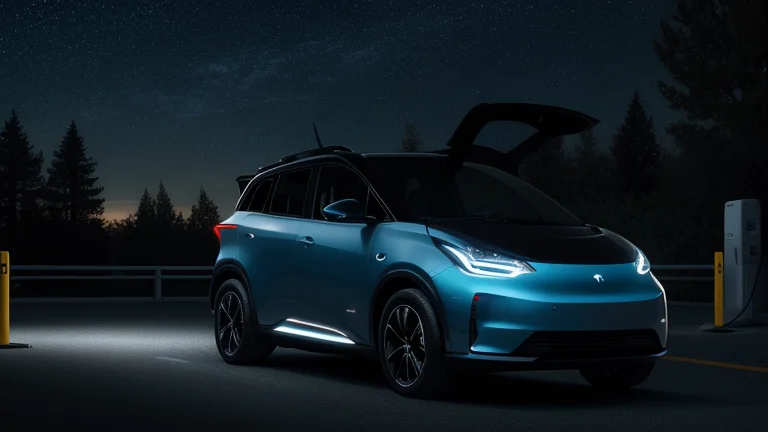
In a parking lot at the Northwest Arkansas Mall, I folded the seats flat, rolled out a foam pad, and slept in the back of my car on purpose — and I loved every minute of it.
Utility mode on, rear air conditioning humming while the front stayed off, a twin foam pad stretched across the back of the Ioniq 9. No hotel. No check-in line. Just a quiet charging stop, a cool cabin, and the realization somewhere around midnight that the car I bought to get us places is also a fantastic place to be. I was grinning about it. Still am.
That’s the thing I keep coming back to after our first big electric road trip: this was fun. We didn’t set out to become EV people — gas prices nudged us there — but a thousand miles in, I’m all the way sold.
Gas Prices Made the Call
The number at the pump never sat still. Up one week, down the next, never where you left it. We wanted a car we could actually count on — steady cost, steady range, no white-knuckling the news every time oil moved. Once we ran the math, the electric answer was obvious, and kind of thrilling: fuel that costs a third of gas and a price we can predict.
The Backwards Decision That Worked
The new car became the road-trip car. The old one became the commuter.
Our 2015 Genesis — eleven years old and still smooth — took over daily driving. Short miles, predictable routes, the boring stuff. The Ioniq 9 got the long hauls and the adventures. Put your reliability where the stakes are highest, and let the paid-off veteran handle the grocery runs.
Then we pointed the Ioniq 9 at a 1,000-plus mile round trip and learned most of what this post is about the hard way.
You Only Need Two Accounts
Here’s the thing nobody tells you before your first big EV trip: you need exactly two charging accounts. ChargePoint and a Tesla subscription. That’s the whole kit.
Stick to Tesla chargers for fast charging. They’re quick, they’re everywhere, and most of the time they’re the cheapest fast option on the road. Because the Ioniq 9 has a native NACS port, you plug straight in — no adapter, no ceremony.
Buc-ee’s was the best charging experience of the trip, full stop. Never once gave me trouble. Another Tesla site decided to quit on me after about a minute of charging, then did it again when I moved to a different stall, and again after that. Two hundred stalls of reliability and then the one that just doesn’t want to work. That’s the road. You roll to the next one.
On price, I paid as much as 62 cents a kilowatt-hour at one stop and averaged around 40 across the trip. ChargePoint, though, was by far the cheapest overall. The night I camped, I found a Level 2 ChargePoint charger at 17 cents a kilowatt-hour — slow, but I was asleep anyway. Slow charging is free time when you’re not awake to spend it.
What Austin Gets Right
Austin is quietly one of the best cities in the country to own an EV, and it’s not close.
It is genuinely cheaper to charge on the city’s public network than it is to charge at home. Some spots run 11 cents a kilowatt-hour. Read the fine print, though — a few chargers say “free” but bill you for time instead of energy. The move there is simple: charge to 80% and leave. Past 80% the car slows its own charging down anyway, so you’d be paying for minutes while the electrons trickle. Get your 80% and get out.
The Road Teaches You Physics
You can read every efficiency tip online, or you can drive 500 miles and feel them in the battery gauge.
Drive the speed limit and the miles come easy. Drive 85 and watch the range evaporate in real time — wind resistance doesn’t negotiate. One-pedal driving saves a real, measurable chunk of energy, feeding the battery every time you lift off the accelerator.
We averaged 2.4 miles per kilowatt-hour. It should have been 2.7 if I’d just been a little more patient with my right foot. My oldest son took a driving shift and turned in a proud 2.1. He’s a good kid. He is not, yet, a leisurely driver. The battery kept the receipts.
A Surprisingly Good Bedroom
Utility mode, seats down, and that twin foam pad slides right into the back with room to spare. The feature I didn’t know I needed: I could shut off the front air conditioning entirely and keep only the rear running. No sense cooling an empty cabin — just the part with a person in it. I slept cool and didn’t feel a bit guilty about the energy.
Note to self for next time: shades. In the future I’ll be investing in some — right now the Ioniq 9 offers approximately zero privacy, and that’s a cheap problem to solve.
Room for Nine (Barely)
The third row might be my favorite thing about this car. When we had visitors in town, we fit nine people in the Ioniq 9 — seven of them comfortably, and the last two in a good-natured squeeze. One vehicle, everybody moves together, nobody follows in a second car. For a machine that also folds flat into a bed for one, that’s a wild amount of range in what it can be.
The Tailgate Lied to Me
Here’s the lesson the spec sheet won’t warn you about. The Ioniq 9’s tail is a lot thinner than its cabin.
We tried to bring home a dresser that would have fit inside the vehicle with room around it — I measured the interior and everything. What I didn’t measure was the tailgate opening, which is meaningfully narrower than the space behind the seats. The dresser and I had a long, sweaty disagreement in a parking lot, and the dresser won. Measure the door, not the room. The cabin will happily hold things you physically cannot get into it.
Where This Leaves Us
We’re EV people now, and I’m a little surprised by how much I mean that. A thousand miles turned a practical decision into a genuine kick — the quiet, the cost, the parking-lot bedroom, even the flaky charger and the dresser that beat me. The old Genesis handles the everyday. The Ioniq 9 handles the memories, and it’s already made a bunch.
The gas prices can keep doing their little dance. We’ll be over here, charging to 80% and heading for the next horizon.
More trips are already on the calendar, and I cannot wait. I’ll report back from the road.
— Randy